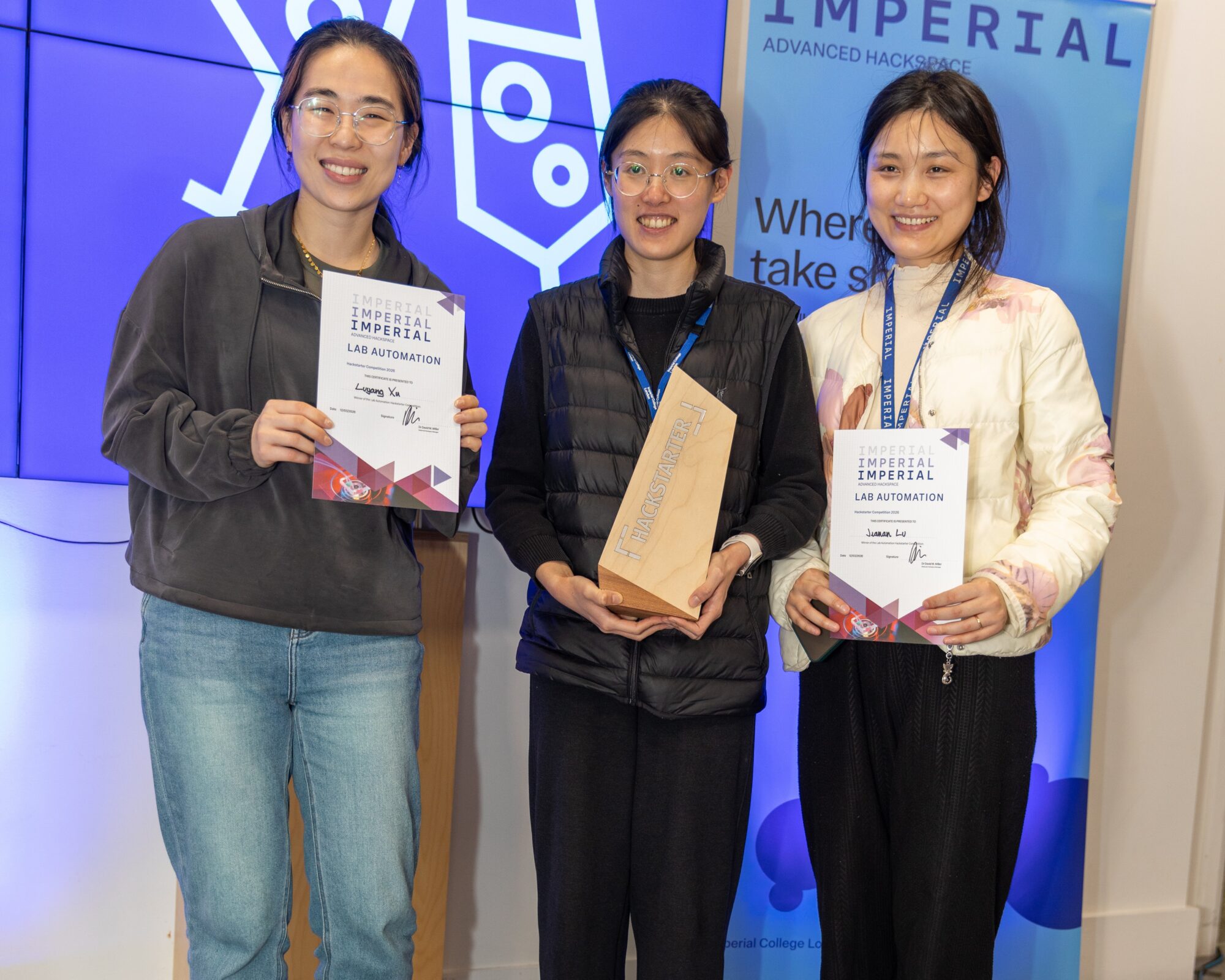
Meet the team
Leah Xu, Co-Founder
Te Bu, Co-Founder
Jianan Liu, Co-Founder
Get in touch
Our Project: Automated Treadmill for Behavioural and Physiological Analysis
An AI-powered treadmill system for smarter, more accessible preclinical research.
The Need For Compact, AI-Powered Motion Analysis
Lab researchers encounter a common challenge: the equipment required to conduct high-quality analysis of motion is often large, prohibitively expensive and slow.
This Hackstarter project addresses this issue directly with a compact, AI-powered treadmill system that automatically tracks movement and monitors physiological function, all within a benchtop device designed to be both accessible and cost-effective.
For scientists studying conditions such as Parkinson’s, ageing, or the effects of new treatments, a fundamental question sits at the heart of their work: how is the subject’s movement changing over time? Yet answering this often involves bulky, expensive equipment and spending hours manually reviewing footage.
This system transforms that process. By combining a compact treadmill with AI-driven analysis, it automatically tracks movement, detects subtle changes in gait, and captures physiological data simultaneously – all within a single, integrated platform. What once required hours of painstaking analysis can now happen in the background, freeing researchers to focus on insight rather than data collection.
The Hackstarter Journey
This idea emerged from identifying a recurring challenge: research teams needed high-quality motion data but were often constrained by the cost, size and complexity of traditional lab equipment.
Hackstarter provided the funding, tools and guidance to turn that need into a working solution. Over the course of the programme, the project evolved from an initial concept into a fully functional prototype complete with integrated AI-powered tracking – demonstrating that the idea wasn’t just promising in theory, but also genuinely workable in practice.
Learning, Building and Looking Ahead
There is something uniquely valuable about actually building a prototype, rather than planning to create one. Developing this device required solving real-world challenges: integrating hardware components, ensuring reliable communication between systems, and achieving reliable AI performance under practical conditions. This hands-on experience taught lessons that no amount of desk research could have.
The next step is getting the device into more labs, so more research teams can use it and provide feedback. In parallel, the team plans to make the hardware designs openly available, allowing others to build, adapt and improve the system globally.
The bigger hope is a simple one: by making high-quality research tools more accessible and affordable, scientists can spend less time working around limitations and more time focusing on discovery.
Hackspace gave us access to a compact prototyping space with all the tools needed for rapid system integration. The combination of expert technical guidance and hands-on support available through Hackstarter made it possible to efficiently develop a working prototype, significantly narrowing the gap between research needs and engineering implementation.
More from Hackspace
Be inspired by our possibilities, facilities and success stories.