
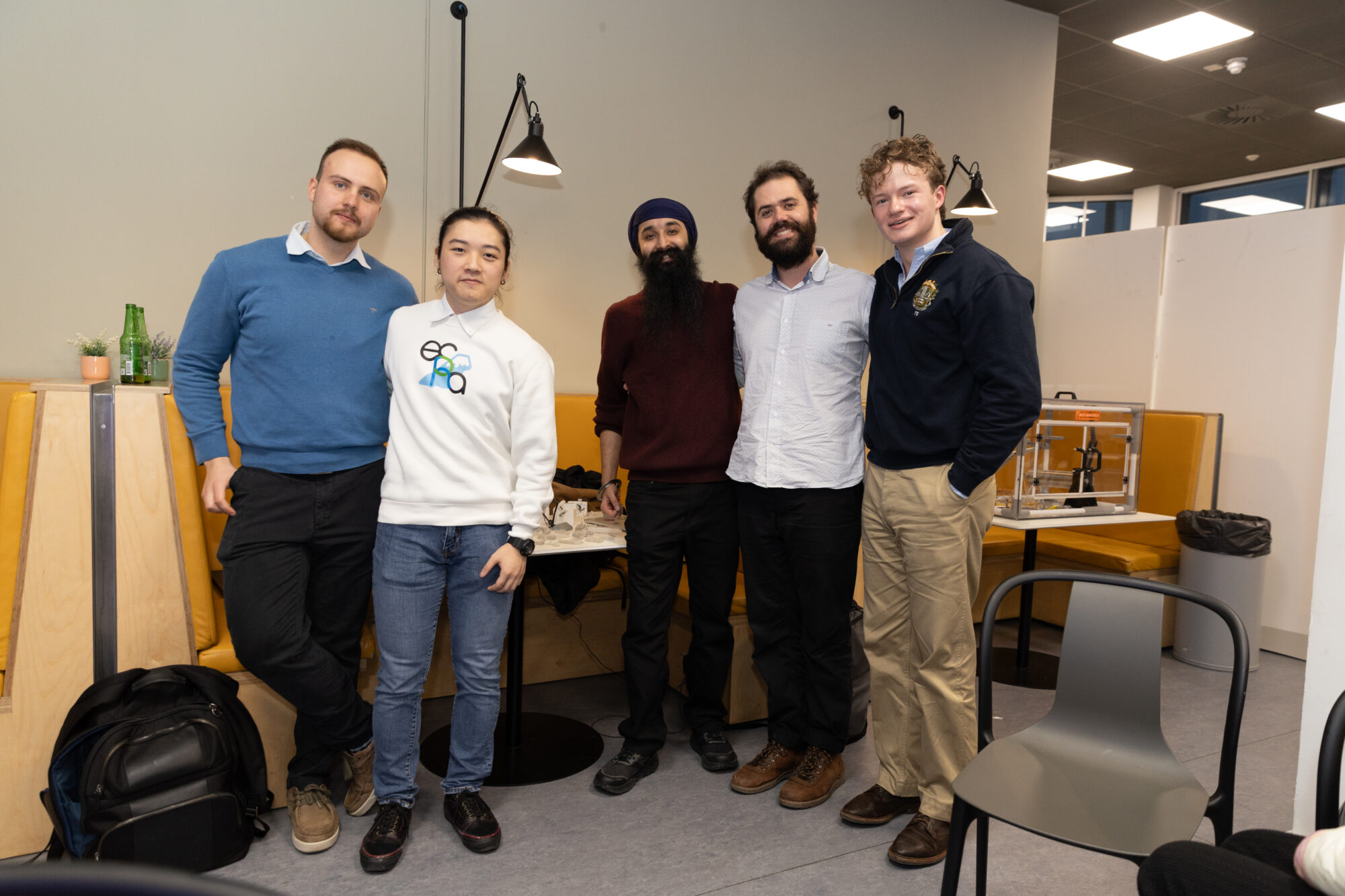
Meet the team
Dr Amritpal Singh, Co-Founder
Dr Noah Sprent, Co-Founder
Fredrick Steinmann, Co-Founder
Povilas Sauciuvienas, Co-Founder
Akihito Gohdo, Co-Founder
Get in touch
Our Project: N-slug
A low-cost, modular automation system that helps biology labs run experiments faster, more reliably and with less manual effort.
N-slug: Making Lab Automation Accessible
Running experiments in a biology lab involves a significant amount of repetitive, highly precise and error-prone manual work. As small inconsistencies during early stages can undermine outcomes, achieving reliable results across different users and points in time is a persistent challenge.
While advanced automation systems exist to resolve this, they are typically large, expensive and designed for industrial-scale facilities rather than university labs or startups.
N-slug addresses this gap with a compact, affordable and flexible automation platform, built using 3D-printed components and off-the-shelf parts. It brings reliable automation to everyday lab environments.
Why This Matters (and Why the Name “N-slug?”)
At the heart of many biology experiments is transformation – the process of getting DNA into a cell so it can be engineered to produce a useful protein or perform a defined function (think of it like reprogramming a cell by inserting new instructions). It’s a critical step, yet one that depends heavily on individual technique, making consistent results difficult to achieve.
N-slug removes this variability by automating the process, creating a reliable and repeatable foundation for experiments. A built-in camera system monitors each step inside the device in real time, feeding data back into the system so it can continuously learn and improve its own performance.
The inspiration for the name “N-slug” actually comes from microfluidics, where the discrete liquid droplets have been referred to and named a “slug”. We thought this name is appropriate given that we are working on larger liquid droplets that still are discrete slugs!
The Hackstarter Journey
The project began with a clear understanding of the problem: existing automation solutions are either too delicate for everyday lab use or too costly and complex for widespread adoption. The space in between – practical, affordable and flexible – remains largely unaddressed.
Through Hackstarter, the team has begun to bridge this gap. Using a millifluidic approach which operates between very small and the very large scales, they have developed modular, chip-based components that can be rapidly 3D printed, tested and reconfigured as needs evolve. Early work has focused on validating the core automation and camera vision system using well-established and low-risk biological process, ensuring that the platform works before expanding its scope.
Learning, Building and Looking Ahead
Bringing together expertise in biology, hardware engineering, computer vision and machine learning within a single physical device, this project has been as much about integration as innovation.
The next step is deployment in a live lab setting, supporting protein production work at an Imperial startup, Change Bio. This will provide an important real-world test of performance.
Looking further ahead, the team plans to release both hardware and software as open source, enabling labs worldwide to build their own version of the platform, adapt and improve it. The longer term ambition is to make reliable, intelligent lab automation accessible to all – reducing barriers to high-quality science and enabling researchers to spend more on discovery and less on manual processes such as pipetting.
Hackstarter was an intense and rewarding experience that gave us the ability to rapidly iterate on our prototype with incredible support from the Hackspace team. It goes far beyond a typical hackathon where you put your existing skills to the test – instead it allowed us to acquire new capabilities thanks to the expert guidance we received.
More from Hackspace
Be inspired by our possibilities, facilities and success stories.

© Copyright Advanced Hackspace | Powered by Imperial College London | Privacy Policy I Accessibility Statement | Website by Herd